Insights
Five levels of organisational AI maturity
26 April 2026 · 9 min read · Daniel van der Merwe · Technical Director
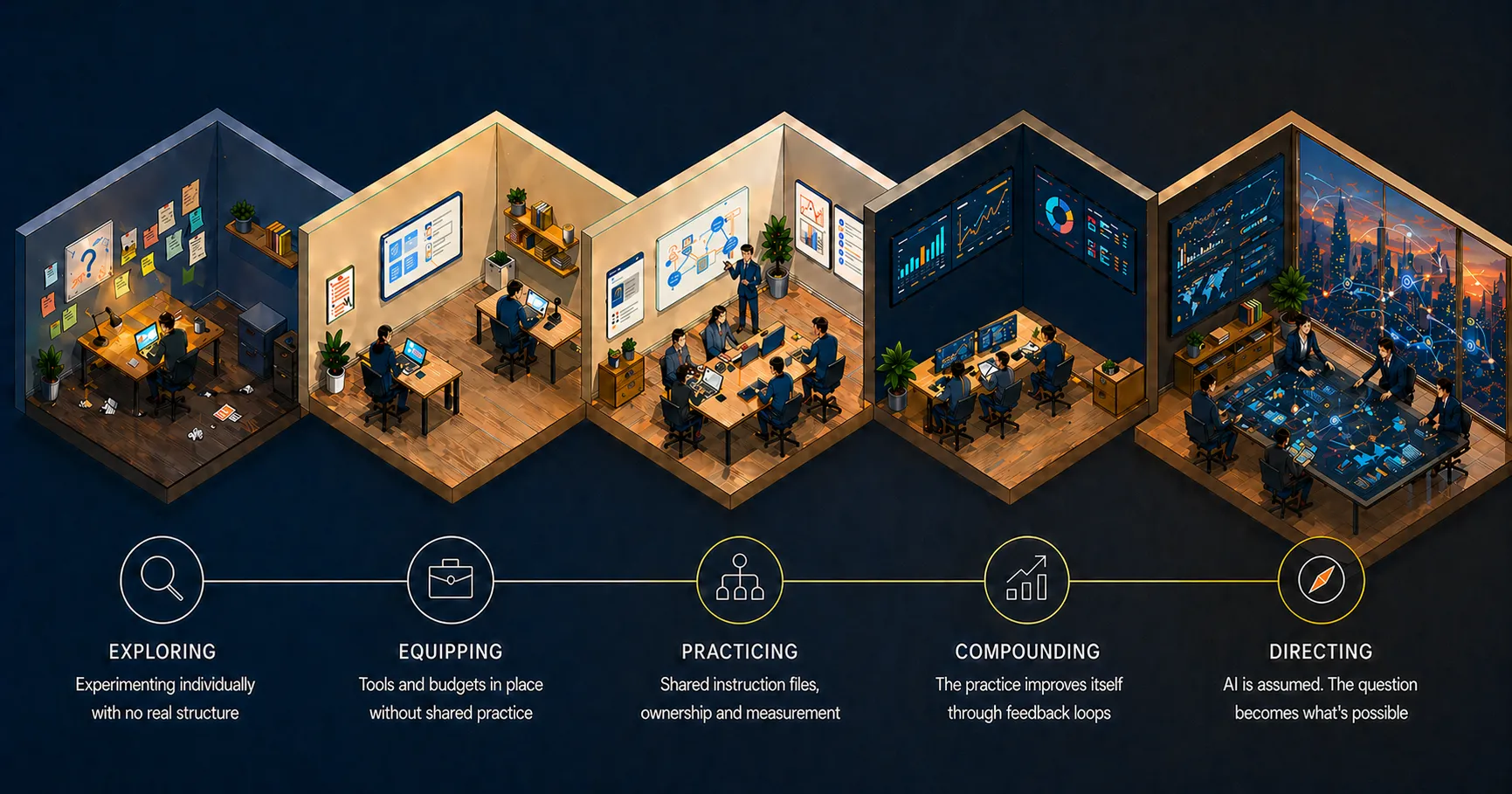
A company recently rolled out hundreds of ChatGPT Enterprise accounts. When usage data was reviewed, “a handful of people were responsible for almost all the meaningful activity.” Most hadn’t logged in after week two. Leadership lacked a framework for evaluating whether this represented success, failure, or an intermediate state.
This scenario repeats across organisations. McKinsey research indicates “88% of organisations now use AI in at least one business function,” yet “only 1% of leaders consider their companies mature in AI deployment.” The gap between using AI and being good at it defines the central challenge.
The lone wolf problem
Individual AI capability differs fundamentally from organisational maturity. A developer building sophisticated multi-agent systems or rebuilding internal chatbots demonstrates personal proficiency but doesn’t necessarily indicate organisational capability. The framework describes this as the “lone wolf” phenomenon: when one exceptional practitioner (called “Sarah” in the piece) creates the illusion of organisational AI maturity.
The distinction matters because “what happened when Sarah goes on leave for three weeks? Or when she moves to another company? You find out very quickly that what looked like organisational maturity was actually one person’s individual capability.”
Level 1: Exploring
This entry-level state characterises most companies initially.
Ground-level dynamics:
- Individual experimentation with AI tools occurs without shared methodology
- “Shadow AI” emerges as employees use personal accounts and paste proprietary data into consumer platforms
- No policies govern usage; documentation exists but remains unread
- IT security hasn’t formally approved or blocked anything
What appears at Level 1:
- Individual experimentation without shared playbooks
- Shadow AI creating unquantified compliance and intellectual property risks
- Absence of usage data preventing understanding of what works
- Leadership cannot distinguish between “we’re doing AI” and “some people are playing with AI”
- AI functions as conversation topic rather than operational reality
Costs involved:
The direct expense is minimal, but opportunity costs prove substantial. Each month at this level represents lost compounding value. Risk costs remain unknowable until incidents occur. A “prompt injection hidden in a GitHub issue title” compromised 4,000 developer machines through the Cline AI coding tool, illustrating ungoverned AI’s vulnerability.
Path to advancement:
Leadership must decide whether AI will become an intentional organisational practice. Choosing not to decide carries hidden costs.
Level 2: Equipping
Most organisations believe they operate here, and many actually land at this level.
Characteristics:
- Enterprise licences are purchased
- Budget exists and vendor relationships are established
- Policy documents may exist alongside a dedicated communication channel
- Adoption concentrates in small user segments
- Multiple proofs of concept emerge, but few reach production
- Shadow AI persists despite sanctioned tools
McKinsey data shows that among the 88% using AI, “roughly two-thirds remain in experiment or pilot mode. Only a third have begun to scale.” Harvard Business Review describes this as a “technology-first trap where organisations deploy AI department by department without linking it to enterprise goals.”
What you observe at Level 2:
- Enterprise licences with adoption in isolated pockets
- Multiple proof-of-concept projects with few production deployments
- Minimal cross-team measurement or observability
- Shadow AI existing alongside sanctioned tools
- AI treated as a budget line item rather than a practice
Cost structure:
Level 2 appears progressive, making departure difficult. No compounding occurs; learning stays isolated to individual projects. Instruction files, system prompts, context documents, and workflow templates either don’t exist or disappear when creators leave. Every new initiative starts from scratch.
Introducing sanctioned tooling without proper learning infrastructure or organisational redesign has “actively slowed teams down” at some companies. Harvard Business Review calls this the “last mile problem”: technical capability meeting organisational design remains the primary obstacle.
Requirements for advancement:
Moving beyond Level 2 requires three elements: an identified owner responsible for building organisational AI working methods (not just vendor management), documented and shared ways of working that are taught and refined, and measurement establishing whether initiatives actually deliver results. Most organisations address the first two superficially while skipping measurement entirely.
Level 3: Practicing
The productivity multiplier activates at this level through organisational practice rather than additional tools.
Distinguishing features:
Level 3 differs from Level 2 through three fundamental organisational elements:
-
Instruction files as infrastructure: System prompts, context documents, coding standards, and workflow definitions reside in version control rather than individuals’ minds or accounts. These receive review, updates, and sharing identical to other critical infrastructure. New team members encounter AI context during onboarding rather than through reverse-engineering.
-
Explicit ownership: Someone specifically responsible for the AI practice across the organisation maintains the playbook, conducts retrospectives, and ensures learnings propagate. This represents an operational role, not a side-of-desk advisory function or monthly committee meeting.
-
Cross-tool observability: Visibility into AI usage, value generation, and ineffective applications enables measurement-based improvement rather than policing.
McKinsey research confirms that “organisations generating the strongest AI returns are nearly three times more likely than others to have fundamentally redesigned their workflows.” The differentiator is organisational rewiring rather than technical access.
Evidence of effectiveness:
ANZ Bank’s GitHub Copilot trial “showed a 42% reduction in task completion time across 100 engineers.” However, individual task speedups only translate to organisational performance when practice infrastructure exists. The 2025 DORA report confirms “AI doesn’t fix a team; it amplifies what’s already there.” Only teams with solid workflows see compounded gains.
Macro data increasingly reflects this. While most companies employ AI for narrow tasks, a “small cohort of power users are compressing weeks of work into hours by automating end-to-end workstreams.”
What characterises Level 3:
- Version-controlled instruction files shared across projects
- Dedicated owner(s) for the AI practice
- Measurement systems revealing what works and what doesn’t
- AI practice onboarding for new team members
- Team-level productivity gains with role-specific metrics
Associated costs:
Coordination overhead increases through shared instruction file maintenance, retrospectives, and learning propagation. Unmaintained instruction files calcify, generating Level 2 results despite Level 3 structure.
Moving toward Level 4:
Advancement requires feedback loops functioning as systems rather than individual activities. A traced bug revealing specification gaps updates instruction files, preventing recurrence on subsequent projects. Governance becomes operational rather than merely documented: data classification, usage policies, and audit trails transition from nice-to-haves to prerequisites. Without them, Level 4’s compounding amplifies risk as rapidly as value.
Level 4: Compounding
At this level, the AI practice transitions from requiring organisational maintenance to maintaining itself through self-improving feedback loops.
Core mechanism:
Instruction files improve across quarters as retrospectives feed findings directly into them. Patterns propagate across projects through system surfacing rather than Slack channel sharing. Institutional memory forms in code and documentation instead of residing in individuals’ expertise.
A concrete example: “A production bug traced back to domain knowledge that existed only in the heads of two developers.” Rather than fixing and moving on, the resolution goes into instruction files that the AI reads on subsequent tasks. The original knowledge holders don’t need to be present; knowledge resides in the system. Scaling across every project and quarter means new teams begin from meaningfully higher baselines.
Rarity and misconceptions:
Most organisations claiming Level 4 actually operate at a strong Level 3 with occasional compounding flashes. True Level 4 requires structural feedback loops (happening by design) rather than incidental ones (happening when someone remembers). Some companies confuse internal tools built by individual developers with compounding; tools lacking test coverage, edge case handling, documentation, or broader understanding represent Level 2 with ambition rather than genuine Level 4 operations.
Barriers to achievement:
Rarity stems from technical and cultural factors. Technically, observability infrastructure tracing outcomes through AI-assisted processes back to shaping instruction files remains unbuilt at most companies. Culturally, compounding requires discipline distinct from shipping discipline: slowing down after success to ask “What made this work, and how do we ensure it persists?” Engineering cultures typically reward shipping and treat reflection as optional.
Level 4 indicators:
- Instruction files evolving based on production outcomes rather than opinions
- Patterns propagating across teams without manual effort
- Observability connecting AI usage to business outcomes
- Practice improving quarter-over-quarter with measurable evidence
- New projects beginning at higher baselines than predecessors
Investment requirements:
The primary investment involves building and maintaining feedback infrastructure and developing cultural commitment to treating AI practice as a compounding system rather than depreciating tools.
Path to Level 5:
Advancement requires strategic reframing beyond viewing AI as an operational capability improving existing work efficiency.
Level 5: Directing
I haven’t seen a company operating consistently at this level. This is where the ladder points, not where anyone has planted a flag.
Fundamental shift:
Levels one through four maintain AI as the question’s subject. Level 5 reframes entirely: “What’s possible now that wasn’t before?” AI drops from the sentence not through ceased relevance but through becoming assumed infrastructure.
The organisational focus transitions from “building a system that improves itself” to “determining where that system applies.” Companies transition from being limited by execution capability to being limited by execution choices.
Operational implications:
- Work previously too risky becomes viable due to reduced wrongness costs
- Work previously too small becomes worthwhile through efficient execution
- Entire project categories open through capability shifts rather than market changes
- Ideas move from conversation to execution rapidly enough that feedback becomes strategy
The broader promise:
Imagine a board meeting addressing market opportunities, Q3 product expansion, and acquisition integration priorities. AI isn’t on the agenda. Not because the board is unaware of it, but because asking about the AI strategy at this point would feel like asking about the electricity strategy. It’s infrastructure. It’s assumed.
This framework ultimately shifts room conversations from “should we?” through “why isn’t it working?”, “how do we make this stick?”, and “how does it keep improving?” to finally “what’s possible now that wasn’t before?”
Where does this leave you?
Current distribution heavily concentrates at Levels 1 and 2. Most organisations claiming Level 3 actually operate at Level 2 with good intentions. Level 4 remains aspirational. Level 5 is directional rather than achieved.
The consequential move of the next three years is the Level 2-to-3 transition. This transition materialises productivity gains, resolves shadow AI, and shifts AI investment from depreciation to compounding. Organisations making this transition within 12–18 months will accumulate value faster than expected; compounding amplifies with earlier initiation.
The three-to-four transition represents long-term value repositories but proves harder and longer. Most organisations aren’t ready. However, companies building genuine feedback loops into AI practices eventually reach difficult-to-replicate positions: compounding systems cannot be purchased; they require accumulated practice construction.
The foundations are boring and they’re what everything else is built on: governance, instruction files, measurement, feedback loops, giving people actual time to learn. Pursuing flashy initiatives while skipping foundations causes Levels 3 and 4 to collapse.
Three questions to locate yourself:
- What happens to AI capability if the two strongest practitioners leave tomorrow?
- Can new team members onboard into the AI practice, or merely into tools?
- Is anyone measuring whether any of this actually works?
These answers typically reveal organisational positioning approximately one level lower than expected.
Daniel van der Merwe is Technical Director at Rokkit200, an AI transformation agency working with engineering and product organisations to build compounding AI practices.
Header image designed with ChatGPT.